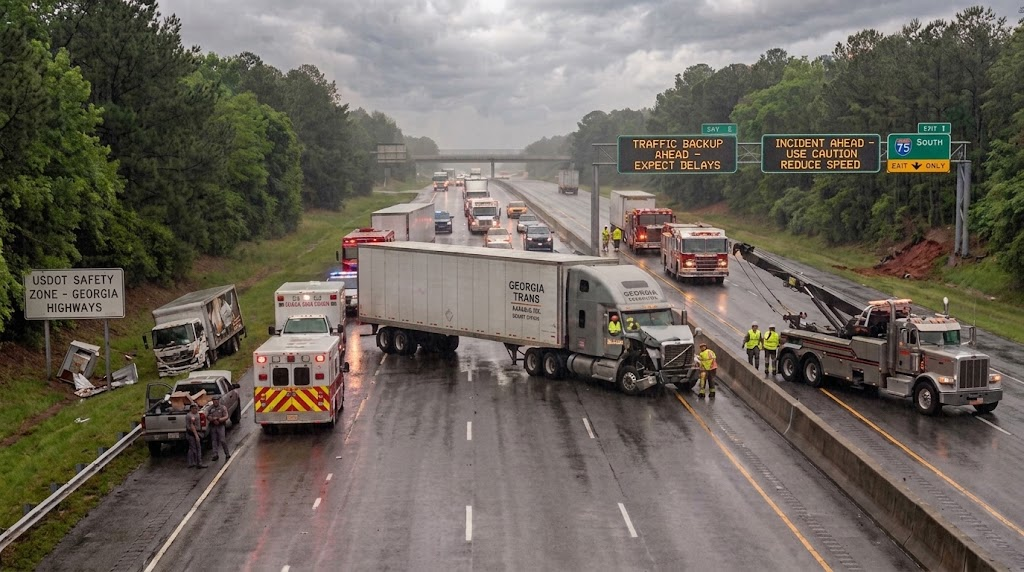
A collision with a fully loaded semi-truck is nothing like an ordinary two-car wreck. A tractor-trailer can weigh up to 80,000 pounds when fully loaded, and that weight is a major reason why truck accidents on Georgia highways so often result in catastrophic injuries or death. If you or someone you love was hurt in a crash involving a commercial truck, the questions on your mind are probably simple: Who is actually responsible for this, and what can I recover?
The honest answer is that truck accident liability in Georgia is rarely simple. Unlike a standard car accident, a trucking case can involve several potentially liable parties, federal safety regulations, and evidence that can start disappearing within days of the crash. This guide walks through how liability generally works under Georgia law, who may be held accountable, what evidence matters most, and what compensation may be available to injury victims and families.
Why Truck Accidents Are Different From Car Accidents
When two passenger vehicles collide, you’re usually dealing with one driver and one insurance policy. Semi-truck accident cases in Georgia are more complex because commercial trucking is a regulated industry. The driver, the trucking company, the truck’s owner, a cargo loading company, and even a freight broker can each carry separate legal exposure depending on their role in what happened. Commercial carriers are also required to follow Federal Motor Carrier Safety Administration (FMCSA) regulations, and violations of those rules are frequently important evidence in a negligence claim.
That complexity is exactly why a tractor-trailer accident on a Georgia highway demands a fast, thorough investigation. Trucking companies often send their own rapid-response teams and insurance adjusters to the scene almost immediately, sometimes before an injured victim has even left the hospital.
Who May Be Liable?
Trucking company liability in Georgia can extend well beyond the person behind the wheel. Depending on the facts, one or more of the following may share responsibility:
- The Truck Driver: Fatigue, distraction, speeding, following too closely, or impaired driving
- The Trucking Company: Negligent hiring, inadequate training, unsafe scheduling, or poor fleet maintenance; a company may also be liable for its employee-driver under respondent superior
- The Manufacturer: A defective tire, brake system, or coupling mechanism may support a product liability claim
- A Cargo Loading Company: Improperly secured or overloaded cargo can cause a jackknife or rollover
- A Broker Or Leasing Company: Liability depends on the entity’s role and level of control over the driver or vehicle
Because Georgia law allows victims to pursue more than one liable party, identifying every responsible entity is often central to the value of a claim.
What if the Truck Driver Was an Independent Contractor?
Many trucking companies classify their drivers as independent contractors rather than employees, and this is one of the most common issues in truck accident litigation. Whether a trucking company can still be held responsible in this situation depends on factors such as how much control the company exercised over the driver’s work, equipment, schedule, and routes, along with applicable law and the specific facts of the relationship. Simply labeling someone an “independent contractor” on paper does not automatically resolve the liability question courts look at the actual working relationship.
FMCSA Violations and Georgia Truck Accident Liability
FMCSA violations are often central to building a strong Georgia truck accident claim. Commercial carriers and drivers are generally required to comply with federal rules covering:
- Hours-of-service limits: Restricting how long a driver can operate without rest, intended to reduce fatigue-related crashes
- Vehicle inspection and maintenance: Requiring regular brake, tire, and equipment checks
- Driver qualification standards: Including licensing, drug and alcohol testing, and training requirements
- Weight and cargo securement rules: Governing load limits and proper cargo distribution
- Electronic logging device (ELD) requirements: Which record driving time and can reveal hours-of-service violations
A violation of these federal safety standards doesn’t automatically decide a case, but it can be significant evidence supporting a negligence claim. That’s why requesting a carrier’s compliance and safety history early in an investigation matters.
What Evidence Proves Truck Accident Liability?
Unlike a routine car accident, commercial trucking crashes generate a large amount of specialized evidence and much of it is time-sensitive. A thorough investigation typically looks at:
- Electronic logging device (ELD) records and paper driver logs
- Onboard electronic data, including information from the truck’s electronic control module (ECM) and other vehicle systems
- Dashcam and surveillance footage from the truck, nearby vehicles, or businesses
- Vehicle maintenance and inspection records
- Driver qualification files, including training and drug/alcohol testing records
- Dispatch communications and trip records
- GPS and telematics data
- Cargo manifests and loading records
- Photographs of the scene, vehicles, and visible injuries
- Witness statements and the official police report
- Accident reconstruction analysis, in more serious cases
Some of this evidence may be subject to limited retention periods or routine data cycling, which is why prompt investigation and preservation requests are important after a serious crash.
Common Causes of Truck Accidents on Georgia Highways
Georgia’s busy interstate corridors including I-285, I-75, I-85, and I-20 carry heavy commercial truck traffic every day, and certain crash patterns show up repeatedly:
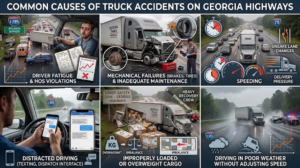
- Driver fatigue from extended hours on the road
- Distracted driving, including cell phone use
- Speeding or unsafe lane changes in heavy traffic
- Poor maintenance leading to tire blowouts or brake failure
- Improperly loaded or overweight cargo
- Driving in poor weather without adjusting speed appropriately
Who Pays for an 18-Wheeler Accident?
The answer depends on who was at fault and what coverage applies. Commercial motor carriers may be subject to substantial minimum-insurance requirements that vary by operation and cargo type, but the actual amount available depends on the applicable policies and how many liable parties are identified.
If the at-fault driver or company is uninsured, underinsured, or disputes liability, your own UM/UIM coverage may also come into play; a full investigation should account for every possible source of recovery.
Insurers often reach out to victims soon after a crash, and speaking with an adjuster before understanding your rights can affect your claim. See our guide on how insurance companies try to minimize car accident claims in Georgia for tactics that apply here too.
Georgia’s Comparative Negligence Rule
Georgia follows a modified comparative negligence system. In general terms, an injured victim’s own compensation can be reduced in proportion to their percentage of fault, and reaching a certain threshold of fault can affect whether recovery is available at all. Trucking companies and their insurers frequently attempt to shift blame onto the victim, in part because doing so can significantly reduce what they owe.
Because the specific statutory language and thresholds matter, this is an area where discussing the facts of your case with an attorney is especially important rather than relying on a general summary.
What You Can Recover After a Georgia Truck Accident
Semi-truck accident compensation in Georgia generally falls into two broad categories: current losses and future losses.
Current losses may include:
- Emergency treatment, hospitalization, and surgery
- Medication and current rehabilitation
- Lost wages already incurred
- Property damage
Future losses may include:
- Ongoing or future medical treatment and surgery
- Long-term rehabilitation or disability-related care
- Reduced future earning capacity
- Long-term or lifetime care needs for catastrophic injuries
Pain and suffering is also generally recoverable. Punitive damages may apply in cases involving particularly egregious conduct, such as impaired driving, though they aren’t automatic and depend on the specific facts.
Catastrophic injuries, spinal cord damage, traumatic brain injury, amputation often require a lifetime of care, so any settlement should account for long-term needs, not just current bills. Our catastrophic injury team works with medical and economic professionals to help project these future costs.
When a Truck Accident Results in a Death
Losing a family member in a truck accident is a different experience than dealing with a serious injury claim, and Georgia law provides a separate legal path for these cases. A wrongful death claim may allow surviving family members to pursue damages for the full value of the life lost, funeral and burial expenses, and the loss of the deceased’s care, companionship, and financial support. A related claim, sometimes brought by the estate, may separately address the deceased’s pain, suffering, and expenses before death. These cases involve their own procedural rules and deadlines, so speaking with an attorney promptly is especially important for grieving families trying to understand their options.

Steps to Protect Your Claim After a Truck Accident
- Seek medical attention immediately, even if injuries seem minor at first.
- Report the crash and obtain a copy of the police report.
- Photograph the scene, vehicle damage, and any visible injuries.
- Avoid giving a recorded statement to the trucking company’s insurer before speaking with an attorney.
- Ask an attorney to send evidence-preservation requests quickly, since some trucking records may not be kept indefinitely.
- Avoid accepting a settlement offer before understanding the full extent of your injuries and losses.
How Long Do You Have to File a Claim in Georgia?
Georgia generally provides a two-year statute of limitations for many personal injury claims, but the applicable deadline can vary depending on the type of claim, the parties involved, and the specific circumstances including cases involving a government entity or a wrongful death. Even when the legal filing deadline is further away, the practical deadline for preserving trucking evidence is often much shorter, since electronic logs, dashcam footage, and other records aren’t always retained indefinitely. If you’ve also been in a standard vehicle collision and want to understand general filing deadlines, our guide on how long you have to file a car accident claim in Georgia covers the general rule in more detail.
Talk to a Georgia Truck Accident Attorney
Truck accident cases move quickly, and the trucking company’s insurer is often building its defense before you’ve even had a chance to fully understand your injuries. At Mark Thomas Injury Lawyer, our team can help investigate the driver, the trucking company, the vehicle, the cargo, maintenance history, applicable safety requirements, and available insurance coverage to help determine how the crash happened and who may be legally responsible. Mark Thomas Injury Lawyer offers a free consultation to review what happened and explain your options, with no fee unless we recover compensation for you.
If you or a family member was hurt or worse in a tractor-trailer accident on a Georgia highway, learn more on our car accident practice page, or contact Mark Thomas Injury Lawyer directly to speak with our team today.
Frequently Asked Questions
Who is liable in a Georgia truck accident?
Liability can fall on the truck driver, the trucking company, a cargo loading company, a parts manufacturer, a broker, or another transportation-related business, depending on the specific facts of the crash.
Who pays after an 18-wheeler accident in Georgia?
Payment typically comes from the at-fault party’s applicable insurance coverage, which may include the trucking company’s commercial policy and, in some cases, other coverage such as your own UM/UIM policy. The exact source and amount depend on the facts and coverage involved.
Can I sue the trucking company directly, or only the driver?
In many cases, a trucking company can be held responsible for its driver’s actions or its own negligence, such as unsafe hiring or maintenance practices, though this depends on the relationship between the driver and the company and the specific facts involved.
What if the truck driver was an independent contractor?
Whether the trucking company can still be held responsible depends on factors like the company’s control over the driver’s work and equipment, applicable law, and the specific facts an independent contractor label alone does not automatically settle the question.
What if I was partially at fault for the accident?
Georgia’s modified comparative negligence rule can reduce compensation based on a victim’s percentage of fault, and reaching a certain threshold can affect eligibility for recovery. An attorney can explain how this may apply to your specific situation.
What evidence helps prove a truck accident claim?
ELD and driver logs, onboard vehicle data, dashcam or surveillance footage, maintenance and inspection records, driver qualification files, dispatch records, and the police report are all commonly used, depending on the case.
How much is a semi-truck accident claim worth?
Value depends on the severity of injuries, current and future medical needs, lost income, applicable insurance coverage, and the specific facts of liability. There is no set amount that applies to every case.
What if the accident resulted in a death?
Georgia law allows surviving family members to pursue a wrongful death claim, which may include damages for the full value of the life lost, funeral expenses, and loss of companionship and support, along with a potentially separate estate claim for pain and suffering before death.
How long do I have to take legal action?
Georgia generally allows two years for many personal injury claims, though the deadline can vary by claim type and circumstances, and evidence preservation is often time-sensitive well before that legal deadline.
This article provides general information about Georgia law and is not legal advice. Every truck accident case depends on its own facts an attorney can evaluate your specific situation.